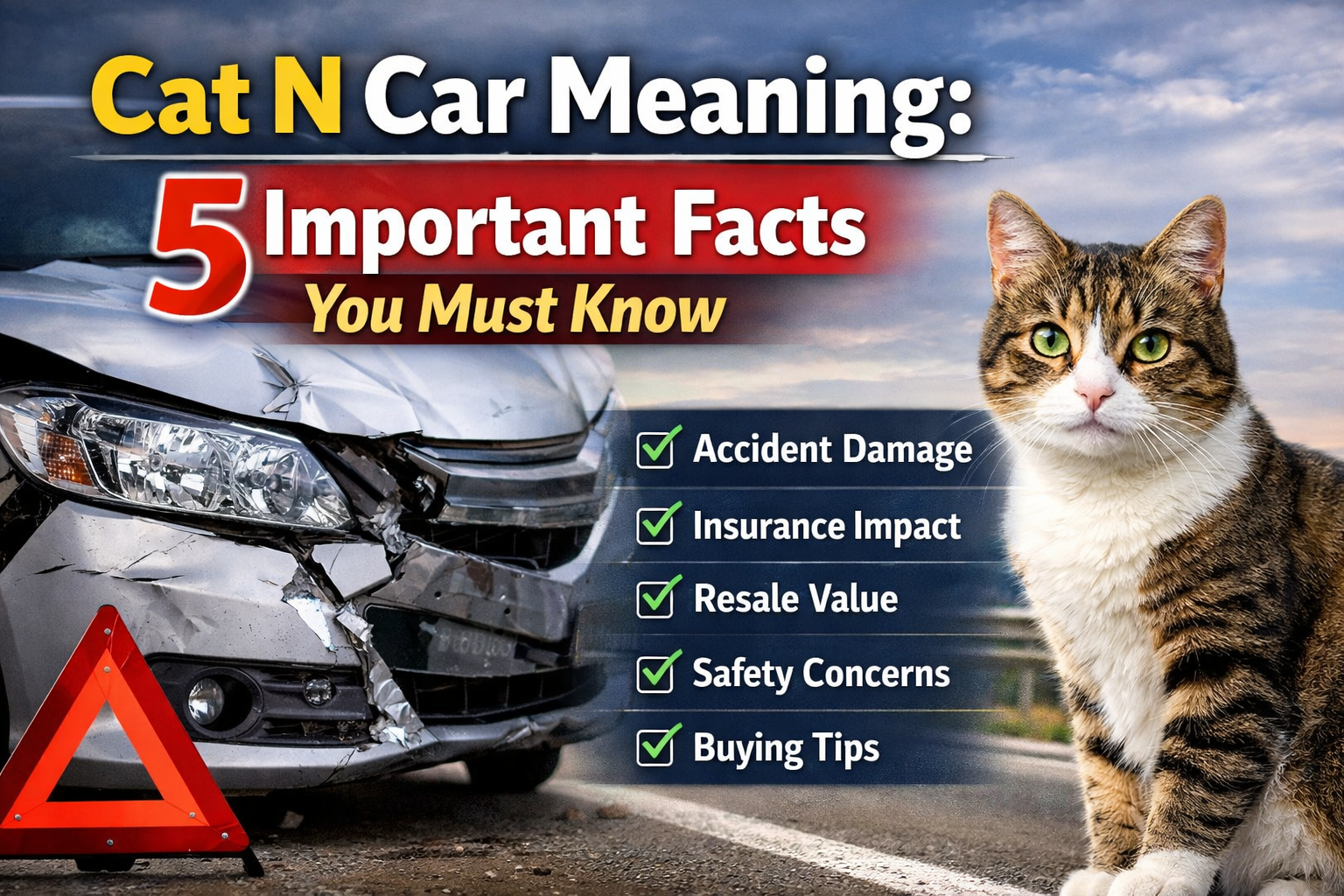
Cat N Car Meaning
Every used-car buyer has been there. You find a listing that looks solid — decent spec, low mileage, reasonable photos — and the price is noticeably lower than anything else on the market. You scroll a little further and spot two letters in the description: Cat N Car Meaning. Suddenly you are not sure whether you have found a bargain or a problem.
Those two letters have a precise, official meaning inside the UK insurance system. They do not automatically mean the car is unsafe, badly fixed, or being sold by someone trying to hide something. But they do mean the vehicle has a history you need to understand before committing to a purchase. This guide walks you through all of it — what Cat N Car Meaning actually means, what to check, whether it is worth buying, and how insurance works when you own one.
At Insuruni.com, we help UK drivers run vehicle history checks backed by blockchain digital records, so you know exactly what you are getting into before any money changes hands.
What Does Cat N Mean?
Category N is one of four insurance write-off classifications used across the United Kingdom. The Association of British Insurers (ABI) introduced the current system in October 2017, replacing the old Cat C and Cat D labels with Cat S and Cat N. The idea behind the change was simple: make it immediately obvious from the category name whether structural damage was involved or not. Cat S stands for Structural. Cat N Car Meaning stands for Non-structural.
A Cat N write-off means the vehicle was declared a total loss on financial grounds, not because it was too dangerous to repair. The insurer looked at the repair estimate and decided it was cheaper to pay the owner the car’s market value and write it off than to cover the workshop bill. Crucially, the car’s frame, chassis, subframe, and structural safety cell were not touched by the damage. The write-off was triggered by non-structural problems — things like cosmetic bodywork, electronics, trim, or mechanical parts.
Once that Cat N Car Meaning marker lands on a vehicle’s history, it is there permanently. It cannot be removed or reversed, and by law it must be declared every single time the car is sold.
What Kind of Damage Typically Results in a Cat N Write-Off?
- Panel, bumper, or bonnet damage that is expensive to fix at a dealership bodyshop but does not compromise the car’s structural safety
- Electrical faults — failed wiring looms, damaged sensors, or dead infotainment systems — where parts costs alone push the bill beyond the car’s value
- Mechanical damage to suspension components, cooling systems, gearboxes, or similar parts
- Interior damage caused by flooding, fire, or vandalism, where the restoration cost outweighs what the car is worth
How Does an Insurance Write-Off Actually Happen?
When a car is damaged — whether in an accident, a flood, a fire, or a break-in — the insurance company sends a damage assessor to look at it. That assessor produces a repair estimate covering parts, labour, and VAT. The insurer then compares that figure to the car’s pre-incident market value. If the repair bill is close to or higher than what the car is worth, the insurer will almost always write it off rather than pay for the work. It is a commercial decision, not a safety one.
The RAC’s write-off category guide explains how each category is assessed in detail, but here is the short version of how the four categories break down:
| Category | Type of Damage | Can It Go Back on the Road? |
| Cat A | Complete destruction | Never. The vehicle must be crushed in its entirety — not even parts can be re-sold. |
| Cat B | Severe structural damage | No. The body shell must be crushed, though some mechanical parts can be salvaged. |
| Cat S | Structural damage to frame or chassis | Yes — but only after a full structural repair by a qualified bodyshop and DVLA re-registration. |
| Cat N | Non-structural damage only | Yes — no DVLA re-registration required. The repair simply needs to be completed to a proper standard. |
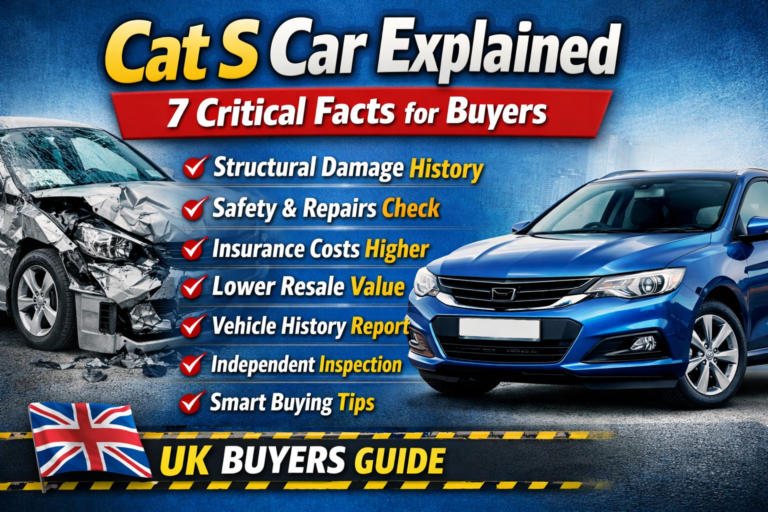
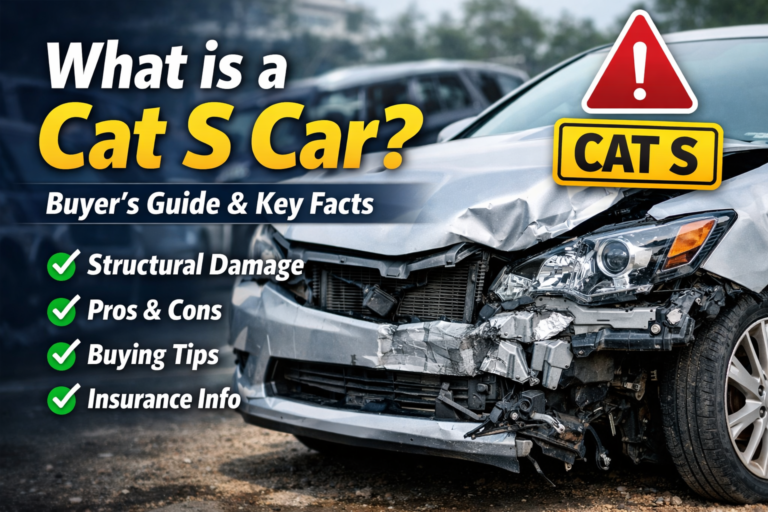
For a closer look at how Cat S differs from Cat N Car Meaning in real ownership terms — running costs, insuring, and what buyers typically find when they inspect one — our full Cat S car guide covers all of it.
Cat N vs Cat S: The Comparison That Matters
Most people browsing written-off vehicles in the UK will come across either Cat N Car Meaning or Cat S. These two categories sit at opposite ends of the damage scale when it comes to the question that matters most to buyers: was the car’s structure affected?
| Factor | Cat N | Cat S |
| Frame or chassis damaged? | No | Yes |
| DVLA re-registration needed? | No | Yes |
| Specialist structural repair required? | No | Yes |
| Typical discount vs market price | 20% – 40% | 30% – 50%+ |
| Mainstream insurers willing to cover? | Most will | Fewer; often specialist-only |
| Buyer risk level | Lower — if repairs are documented | Higher — structural integrity must be verified |
If you are looking at a Cat S listing and want to understand what you are taking on, read our Cat S explainer before you go any further. Structural damage means an entirely different level of scrutiny before purchase.
Is a Cat N Car Meaning Safe to Drive?
In the vast majority of cases, yes — as long as the repairs were carried out properly. The whole point of the Cat N classification is that the car’s structural safety is not in question. The crumple zones, side-impact reinforcements, safety cage, and sill structures are all intact, exactly as the manufacturer designed them. That matters a great deal in a collision.
What you are really evaluating with a Cat N Car Meaning is the quality of the cosmetic, electrical, or mechanical work that was done after the incident. A poorly resprayed panel is an annoyance. Improperly repaired brakes, suspension, or wiring are a safety issue. The category tells you the structure is fine — your job as a buyer is to confirm that everything else was fixed properly too.
Five Checks to Do Before You Buy
- Run a full vehicle history check. Providers like HPI Check and Experian AutoCheck will confirm the Cat N status, flag any outstanding finance, search the stolen vehicle register, and highlight any number-plate changes or mileage discrepancies.
- Check the MOT history in full. The DVSA’s free MOT history checker shows every test result, advisory notice, and failure going back years. A clean record after the incident date, with no suspicious gaps, is a genuinely reassuring sign.
- Verify the registration details. Use the GOV.UK Vehicle Enquiry Service to cross-check the engine size, colour, registered keeper count, and tax status against what the seller has told you. It is free and takes under a minute.
- Get an independent inspection. Pay a qualified mechanic — ideally one with experience in accident-damaged vehicles — to inspect the car before you commit. They should check panel gaps and paint depth readings across every panel, probe the electrics, and look underneath for signs of anything that was missed or bodged.
Ask for the full repair paper trail. A reputable seller will have invoices from the repairing garage, before-and-after photographs of the damage, and a list of every part replaced. If they cannot produce those documents, treat it as a firm reason not to buy.
Should You Buy a Cat N Car Meaning?
The honest answer is that it depends entirely on the specific car in front of you, not the category label. A well-repaired Cat N vehicle with full documentation and a fair asking price can be one of the best-value used-car purchases available in the UK right now. The same category on a car with missing paperwork, a dodgy MOT history, and a suspiciously high price is a very different proposition.
The numbers are worth spelling out. Cat N Car Meaning typically sell at a 20% to 40% discount against equivalent undamaged stock. On a car with a standard market value of £12,000, that means paying somewhere between £7,200 and £9,600. The discount you get on the way in roughly mirrors the resale penalty you will face on the way out — which means, for buyers who plan to keep a car for three or more years, the financial equation is often neutral or even slightly in their favour compared to buying an undamaged vehicle at full price.
When a Cat N Car Meaning Is the Right Call
- You want a better-specified car than your budget would otherwise stretch to
- You are buying practical daily transport and condition matters less than reliability and value
- The car comes with complete repair documentation from a reputable workshop and a clean MOT record since the incident
- An independent mechanic has inspected it and confirmed the repairs are sound
- The price genuinely reflects the write-off history — not just a token £200 knocked off
When to Walk Away
- The seller has no repair invoices, no photographs of the damage, and no paper trail from the garage
- The MOT history shows failures or a suspicious gap in the months following the incident
- The VIN stamped on the dashboard, door sill, and V5C logbook do not all match
- A paint depth gauge shows significant variation across adjacent panels — a tell-tale sign of a hidden repair
- The asking price is barely below standard market value for the model, with the Cat N status treated as a footnote
Getting Insurance on a Cat N Car Meaning
You can insure a Cat N Car Meaning. Most mainstream UK insurers will provide cover, and in many cases the premium is not dramatically higher than for an equivalent undamaged vehicle — particularly if you can demonstrate the repairs were completed properly. The two things you absolutely cannot do are omit the write-off status when applying, or assume the insurer already knows.
A write-off classification is a material fact in insurance law. If you fail to disclose it and later make a claim, the insurer can void your policy from the start, refuse the claim in full, and potentially refuse to return the premiums you paid. It is not worth the risk. Declare it every time, on every quote, with every provider.
Beyond disclosure, it pays to shop around properly. Some insurers load Cat N vehicles heavily; others apply minimal uplift if the repair documentation is solid. If you are arranging drive-away insurance to get the car home the same day you buy it, make sure that short-term policy also discloses the Cat N status — even temporary cover is not exempt from the duty to declare.
If you are running a small business and need to add a Cat N vehicle to a company fleet, it is worth checking whether your existing business insurance arrangements can extend to cover it, or whether a standalone policy is the cleaner option.
Five Practical Tips for Cat N Insurance
- Declare the Cat N write-off on every single application without exception
- Hand over the full repair documentation to your insurer — it gives them confidence in the vehicle and can bring the premium down
- Collect quotes from at least five providers, including brokers who specialise in non-standard or accident-repaired vehicles
- Ask each insurer explicitly whether a future claim will be settled at Cat N market value or at standard book value — those can be very different figures
- If the insurer’s own valuation of the car seems low, consider agreed-value cover so there are no surprises at claim time
Where to Find Cat N Car Meaning for Sale
Cat N stock appears on most of the major used-car platforms in the UK, as well as through specialist salvage auction houses. The important thing is to use platforms that display the write-off category clearly in the listing — and then to verify that status independently before you get too attached to a particular car.
AutoTrader is the biggest used-car marketplace in the UK and allows you to filter search results by write-off category, which makes finding Cat N stock straightforward. Motors.co.uk carries similarly broad national inventory. If you are open to buying from auction — where the deepest discounts tend to be — both Copart UK and BCA (British Car Auctions) run regular sales that include Cat N lots. Just be aware that auction purchases come with limited inspection time, so running an HPI Check on any vehicle before you bid is not optional — it is essential.
Cat N Car Meaning are sold across the whole country, but certain cities have notably higher concentrations of specialist dealers and salvage stock:
- London — the highest volume of Cat N listings in the UK, with multiple specialist dealers who carry verified repair histories as standard
- Manchester — a strong market, particularly for ex-fleet and ex-lease stock that often comes with full service records
- Birmingham — one of the country’s main salvage-trade hubs, with wide variety across makes and price points
- Glasgow — the largest Cat N market in Scotland, with dealers covering the Central Belt and beyond
- Bristol — a growing inventory, particularly strong in ex-fleet categories
- Leeds and Sheffield — competitive pricing on Cat N stock throughout the north of England
Common Questions About Cat N Car Meaning
The Bottom Line
A Cat N Car Meaning is not something to avoid on principle. It is something to research thoroughly. The structure is intact, the write-off happened for financial rather than safety reasons, and the car can be every bit as reliable and roadworthy as one that has never been near an insurance claim — provided the repairs were done right and the paperwork backs them up.
The process is straightforward if you follow it in order. Check the history through HPI, review the full MOT record on the DVSA’s tool, get an independent mechanic to look it over, read every page of the repair documentation, and then insure it with full disclosure. Do all of that and a Cat N Car Meaning is a genuinely smart purchase for the right buyer at the right price.For more on UK car insurance, you can browse Prima Car Insurance, explore all our auto insurance guides, or if you need a vehicle history check run right now, head to Insuruni.com and use our blockchain-backed verification tool.