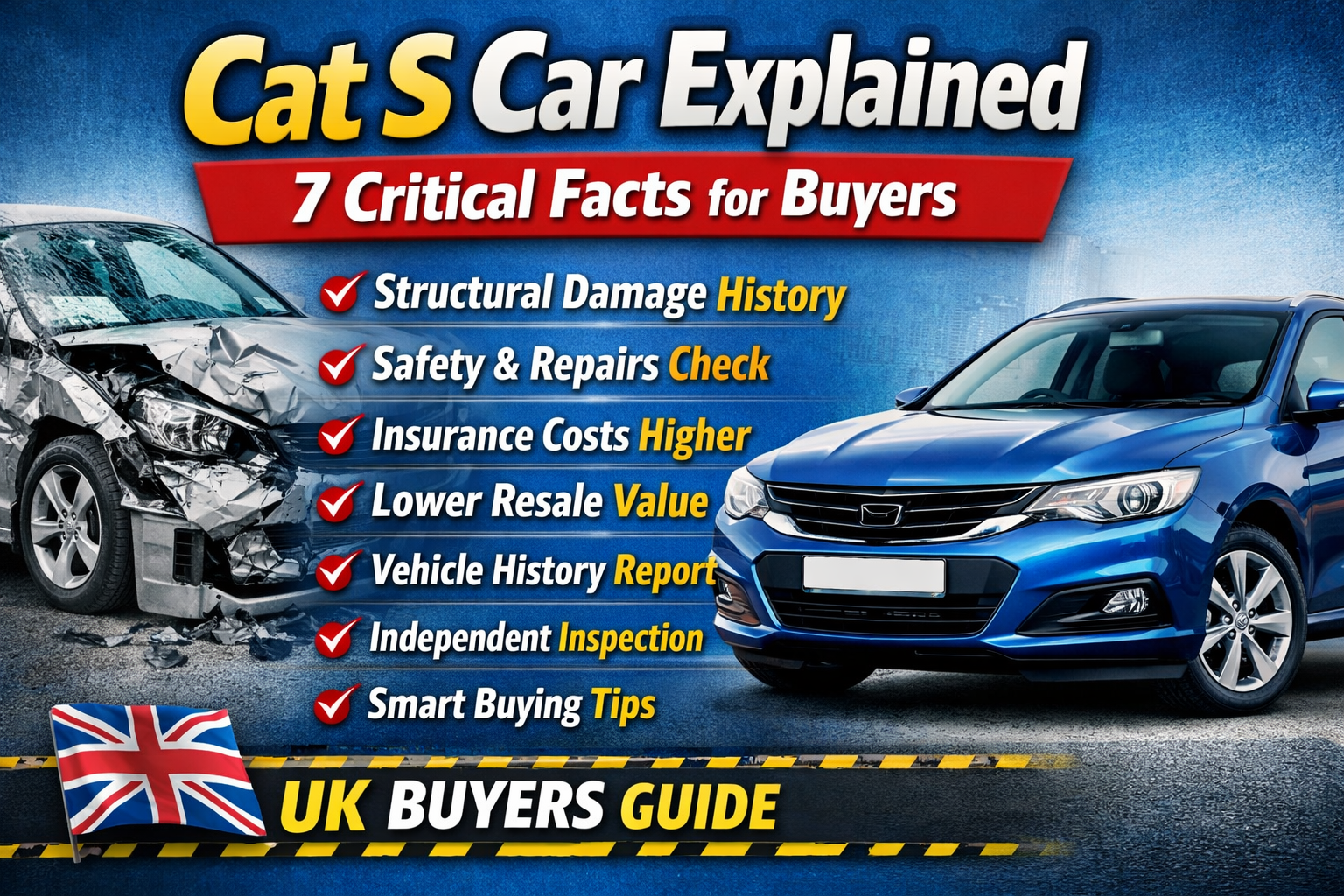
Cat S Car
What Is a Cat S Car?
So you have spotted a used car at a price that seems almost too good to be true. You scroll through the listing, the mileage looks decent, the photos are fine — then you notice two letters near the top: Cat S. Before you click away or, worse, hand over your money without understanding what you are looking at, let me walk you through everything it means.
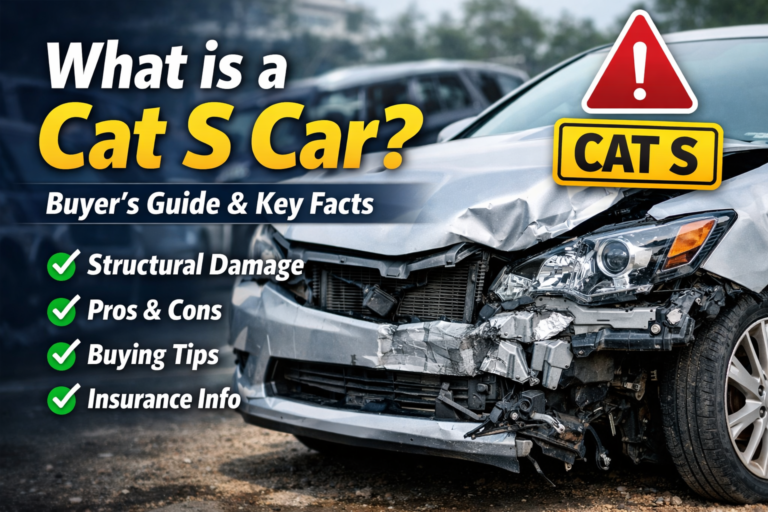
A Cat S car is a vehicle that an insurance company has officially written off because it sustained structural damage in an accident. The S literally stands for structural. This is not a car with a scraped bumper or a dented door — Category S means the car’s load-bearing framework, the skeleton that holds the whole thing together and keeps you safe in a crash, has been damaged in some way.
Now here is the part that surprises a lot of people. Written off does not mean destroyed. It means the insurer decided the repair bill would cost more than a set percentage of the car’s market value at the time of the accident, making it uneconomical for them to fund the work. The car may still be perfectly repairable. Thousands of Cat S vehicles are professionally restored every single year and go back on UK roads without any issues.
One thing worth knowing upfront: Cat S replaced what used to be called Category C back before 2017. The Association of British Insurers updated the whole write-off classification system to better reflect modern repair standards. Under the current setup, damaged cars are either Cat S (structural damage) or Cat N (non-structural damage), replacing the old Cat C and Cat D labels.
The Full Picture: All Four UK Write-Off Categories
Before we go any deeper on Cat S, it helps to see where it sits within the broader system. UK insurers use four write-off categories, each describing how badly damaged a vehicle is and whether it can ever drive again.
Category A
The car is so thoroughly wrecked that it has to be crushed completely. Nothing can be reused, not even the parts. This is as bad as it gets.
Category B
The body shell must be destroyed, but salvageable mechanical and electrical components can be stripped out and reused on other vehicles. The car as a whole is finished.
Category S
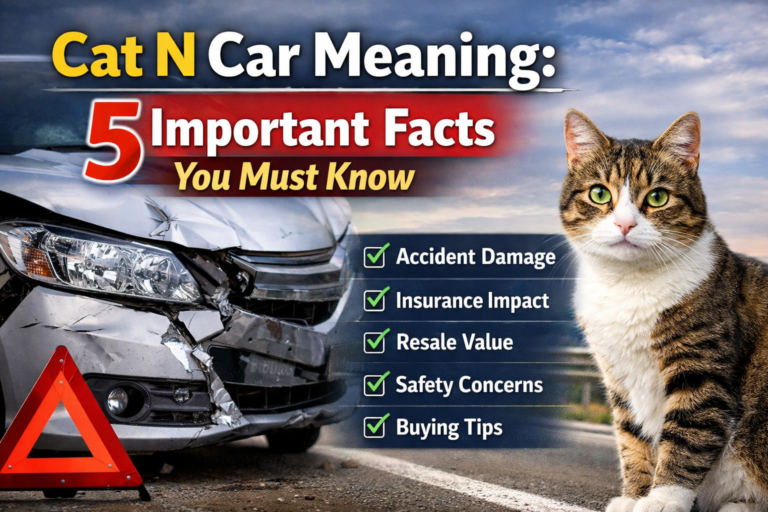
Structural damage has happened to the chassis or body frame. The car can return to the road, but only after a proper professional repair and a formal re-registration with the DVLA.Category N — Non-structural damage only. Things like cosmetic bodywork, electrics, or interior trim. The car can be fixed and driven again without any re-registration required. For a full breakdown of how this works, take a look at our guide on Cat N cars.
Cat S and Cat N are the only two categories where a vehicle can legally return to UK roads after repair. If a car is Cat A or Cat B, it must never be driven again under any circumstances.
What Does Structural Damage Actually Mean in Practice?
This is the question most buyers get wrong, so it is worth being precise. Structural damage does not simply mean the car took a hard knock. It refers to damage done to the load-bearing skeleton of the vehicle — the parts that engineers specifically design to protect the people inside during a collision.
Most modern cars are built using what is called a unibody or monocoque structure. Rather than a traditional body bolted onto a separate chassis, everything is welded together as a single integrated unit. Certain sections of that unit are deliberately engineered to crumple, fold, or flex in a controlled way when a crash happens, absorbing energy and redirecting it away from the occupants. When those sections get bent or compressed, the car earns a Cat S marker.
The structural parts most commonly affected include:
- Chassis rails and sill sections — the long beams running underneath the car from front to back
- A-pillars, B-pillars, and C-pillars — the vertical supports that frame your windows and doors on either side
- Front and rear crumple zones — the sections at each end of the car designed to absorb impact energy
- The bulkhead and firewall — the barrier between the engine bay and the passenger cabin
- Suspension turrets and subframe mounting points — where the suspension and subframe connect to the body
- Floor pan and seat mounting areas — the platform your seats and seatbelts anchor to
Putting these areas right is not a job for a regular garage. It requires a specialist bodyshop with a vehicle alignment jig — a piece of equipment that takes precise measurements and uses hydraulic force to pull structural sections back to the manufacturer’s exact original specifications. Without it, you cannot know whether the car’s geometry is truly correct.
Cat S vs Cat N: What Is the Real Difference?
Plenty of buyers treat Cat S and Cat N as roughly the same thing. They are not, and the differences matter when it comes to your safety, your insurance costs, and what the car is worth when you come to sell.
| Feature | Cat S | Cat N |
|---|---|---|
| Damage type | Structural — chassis, pillars, crumple zones | Non-structural — cosmetic, electrical, trim |
| DVLA re-registration | Required before road use | Not required |
| Repair complexity | High — needs specialist jig equipment | Moderate — standard bodyshop |
| Safety risk | Significant if poorly repaired | Usually low — mostly cosmetic |
| Typical price saving | 20% to 40% off clean-title value | 10% to 25% off clean-title value |
| Insurance cost | Higher; some insurers add conditions | Slightly higher; most insurers cover |
| Resale impact | Major — marker is permanent | Moderate — some buyers accept Cat N |
| Finance availability | Very limited — most lenders decline | Limited but more options available |
The short version: Cat S is the more serious category on every measure that matters. A well-repaired Cat S car can still be a solid buy, but it demands more homework than a Cat N equivalent. Go in with your eyes open.
Is a Cat S Car Actually Safe to Drive?
The safety of a Cat S car comes down to one thing only: how well it was repaired. A professionally restored Cat S car can be just as safe as any car that has never been in an accident.
When a qualified structural repair specialist does the work properly — using the right jig equipment, manufacturer-approved techniques, and quality materials — the car’s structural integrity can be fully restored. It will behave exactly as the engineers intended, both in everyday use and in a collision.
The danger is when repairs are done cheaply, quickly, or by someone without the right skills and equipment. A chassis rail that looks fine to the eye but sits slightly out of alignment on a jig can behave very differently in a crash. Substandard welds, filled crumple zones, or weakened pillars can reduce the car’s ability to protect you in a subsequent impact — and none of that is visible on a test drive.
This is why independent inspection is not optional. It is the single most important step in the whole process.
Five Things You Must Do Before Buying Any Cat S Car
- Get an independent inspection done. Find a qualified mechanic or structural repair specialist who has no stake in the sale. Pay for a full pre-purchase check. This is the one step you cannot skip.
- Ask for every piece of repair documentation. That means invoices, photographs taken during the repair work itself, and the name of the bodyshop that carried it out. If the seller cannot produce these documents, that tells you something important.
- Check the full MOT history. Visit gov.uk/check-mot-history and look at every result since the incident. Confirm the car passed an MOT after the structural repair was completed, not just before the accident.
- Run a proper vehicle history check. Use a service like HPI Check, Experian AutoCheck, or the RAC Vehicle History Check to confirm the write-off category, the date of the accident, and whether the car has any outstanding finance against it.
Verify the DVLA re-registration. Cat S cars must be formally re-registered with the DVLA before they can return to the road. Check the V5C logbook and make sure this has actually been done.
What the Law Says About Returning a Cat S Car to the Road
Unlike Cat N, you cannot fix a Cat S car and simply start driving it. UK law requires the vehicle to be formally re-registered with the DVLA once structural repairs are finished. This is not a technicality you can skip — it is a legal requirement, and it creates a permanent record of the vehicle’s history.
The process itself is fairly straightforward:
- Notify the DVLA that the salvaged vehicle has been repaired and you intend to return it to use
- Complete the paperwork to obtain a new V5C logbook. This will carry the Cat S marker, which stays there permanently and cannot be removed
- Make sure the car passes a valid MOT test carried out after the repairs are finished, not before
Once you have a current MOT and a properly issued V5C, the car is entirely legal to drive anywhere on UK public roads. The Category S marker stays on the record forever, but it does not restrict road use in any way.For official guidance on notifying the DVLA, you can visit gov.uk/change-vehicle-details-registration-certificate.
Insuring a Cat S Car: What to Expect
Yes, Cat S cars can be insured. Most mainstream UK insurers will cover a properly repaired and re-registered Cat S vehicle. That said, there are some things worth knowing before you start getting quotes.
- Always tell the insurer about the Cat S category.
Every insurance application asks you to describe the vehicle and its history accurately. Not mentioning the Cat S marker is likely to invalidate your entire policy, and in the worst case, it can be treated as fraud. Just be upfront — it is far simpler. - Your premiums will probably be a bit higher.
Insurers view previously damaged cars as carrying slightly more risk, and Cat S vehicles are harder to value precisely. Some providers will charge noticeably more; others will not. Comparing several quotes is essential, not optional. - Some insurers want to see the repair evidence.
Before they agree to cover a Cat S car, certain providers will ask for proof that structural work was done professionally. If you have all your invoices and inspection reports organised and ready, this is straightforward. - If mainstream insurers are not playing ball, try a specialist broker.
Specialist brokers deal with non-standard vehicles day in and day out, including write-offs and salvage cars. They often find better terms than a comparison site will surface. Start with a comparison site to get a benchmark, then follow up with a specialist.
The Association of British Insurers publishes useful guidance for consumers on how write-off categories affect insurance cover, worth a read if you want to understand how underwriters think about it.
What to Realistically Expect on Price
The biggest draw of a Cat S car is, let’s be honest, the price. Because the write-off marker permanently reduces a vehicle’s market value, Cat S cars typically sell for 20% to 40% less than a comparable clean-title equivalent. The exact gap depends on make, model, age, and the severity and quality of the repair.
In real terms, that could mean the difference between a three-year-old family car and a one-year-old model. Or between a base trim and a fully loaded spec within the same budget. That is a genuine and meaningful advantage for the right buyer.
Before you get too excited about the discount, though, it is worth thinking through the full financial picture of owning a Cat S car:
- Insurance premiums will generally be higher than for an equivalent clean-title vehicle, sometimes noticeably so
- Resale value stays lower for the entire life of the car. Future buyers will see that Cat S marker just as clearly as you can today, and they will price accordingly
- Getting finance is genuinely difficult — most mainstream lenders and manufacturer PCP or HP schemes will not fund Cat S vehicles
- Private buyers can be wary, especially those who do not know much about write-off categories. Expect more questions, more hesitation, and a longer selling process
For someone paying cash, planning to keep the car long-term, and willing to put the work in upfront, a well-repaired Cat S car can be genuinely excellent value. For someone who needs finance, expects to sell within a year or two, or is new to the used car market, the calculation is less straightforward.
How to Check a Car’s Write-Off History
This is not something to take on trust. Never rely solely on what a seller tells you about a car’s history. Always run your own independent check before you part with any money. The most widely used services in the UK are:
- HPI Check — the industry gold standard for UK vehicle history checks. Covers write-off category, outstanding finance, stolen status, mileage discrepancies, and plate changes
- Experian AutoCheck — thorough background data including write-offs, finance, and MOT history
- RAC Vehicle History Check — covers write-off category alongside other useful background checks
- DVLA MOT History — free official government service showing every MOT result and advisory notice on record
A full history check typically costs between £10 and £25 depending on the provider. Given you are buying a car with a documented structural damage history, treating this step as optional is not a risk worth taking.
The Real Advantages of Buying a Cat S Car
It is easy to get so caught up in the caveats around Cat S cars that you lose sight of why many experienced buyers genuinely rate them. When you approach it carefully and with the right support, there are real benefits here.
- A substantial saving on purchase price.
Saving 20% to 40% versus a clean equivalent is real money. On a £15,000 car, that is potentially £3,000 to £6,000 back in your pocket. - Better cars within your budget.
That same saving means you can sometimes afford a newer model year, a lower mileage, or a higher specification than you could from clean stock within the same spending limit. - Fully legal road use once re-registered.
Once a Cat S car is professionally repaired and correctly re-registered with the DVLA, it carries no restrictions whatsoever. Tax it, insure it, drive it anywhere. - The damage history is actually on the record.
This one surprises people. A Cat S marker means you know exactly what happened and when. Many clean-title used cars have had minor accidents that were never declared to an insurer and never appear on any history check. In some ways, a documented Cat S car is more honest than a supposedly clean car with a hidden past. - Properly repaired structural sections can be extremely durable.
When a qualified specialist does the work correctly using modern equipment and quality materials, repaired structural sections can be as strong as the original factory build. In some cases, freshly welded and treated metalwork can actually be more corrosion-resistant than the original pressed steel.
Who Is a Cat S Car Right For — and Who Should Probably Avoid It?
Cat S Is Generally a Good Fit If You Are
- An experienced used car buyer who knows what a proper independent inspection looks like and has a mechanic you trust
- Planning to keep the car for several years and not particularly concerned about resale value down the line
- Paying cash, since most mainstream lenders simply will not touch Cat S vehicles
- Mechanically knowledgeable, or at least have someone in your corner who is and can assess repair quality on your behalf
- A business or fleet buyer who buys on value and has the in-house knowledge to evaluate what you are looking at
Cat S Is Probably Not Right If You Are
- Buying your first car and do not yet know what good versus bad repair work looks like
- Relying on finance, as your options are very limited and terms are typically worse when available at all
- Planning to sell within a year or two, since the permanent marker will meaningfully reduce what future buyers will pay
In a rush, because doing this properly — inspection, documentation, history checks — takes time that cannot be cut short without adding risk