
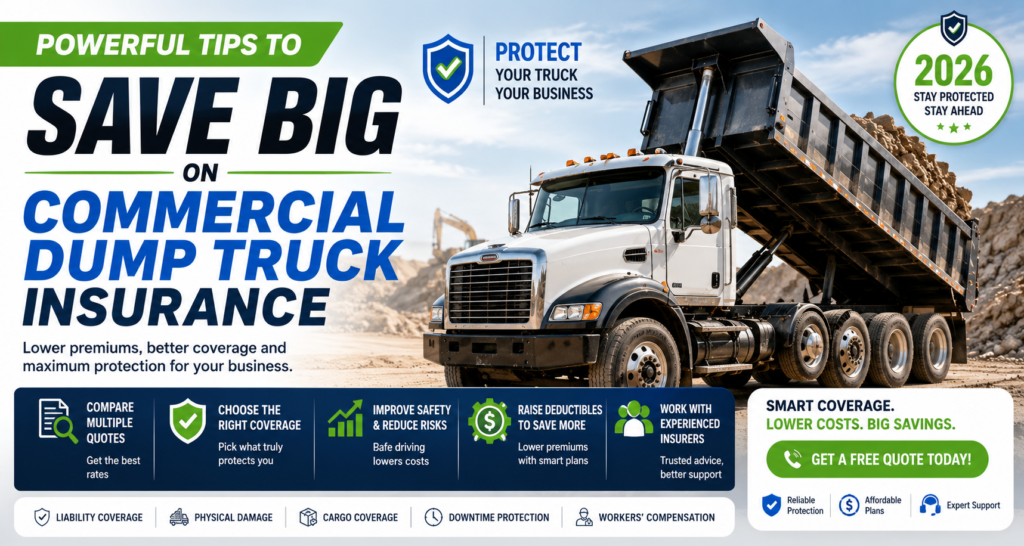
Commercial Dump Truck Insurance
I’m going to skip the corporate intro and get straight to it.
If you own a dump truck — or even a fleet of them — and you’re out there hauling gravel, sand, topsoil, demo debris, or anything else five days a week, you already know that insurance is one of those necessary evils you can’t afford to get wrong. One bad accident. One uninsured load. One lawsuit from a driver who says your gravel cracked their windshield on the highway. And suddenly, years of hard work are on the line.
The problem isn’t that dump truck operators don’t take insurance seriously. Most do. The problem is that the insurance industry does a terrible job explaining what you actually need, what you’re actually buying, and whether you’re actually protected — or just technically covered on paper.
This guide is going to change that. I’m going to walk you through Commercial Dump Truck Insurance like a friend who’s done the research and isn’t trying to sell you anything. By the end of this, you’ll know exactly what coverage makes sense for your operation, what it should cost, how to find the best rates, and what questions to ask before you sign anything.
Let’s get into it.
What Is Commercial Dump Truck Insurance and Why Can’t You Just Use Your Regular Policy?
Commercial Dump Truck Insurance is a specialized commercial auto policy designed specifically for trucks used in a business capacity to transport bulk materials. It’s not the same as a personal truck policy, a standard Commercial Dump Truck Insurance auto policy, or a farm vehicle policy — and those distinctions matter a lot more than most people realize.
Here’s a scenario that plays out more often than it should
A guy starts hauling gravel on weekends for a neighbor. Small jobs, a few hundred dollars here and there. He figures his regular truck insurance is fine. Then one afternoon he misjudges a turn on a two-lane road, clips an oncoming car, and causes a serious accident. The other driver is hospitalized. The bills start stacking up. When the dust settles, his insurer looks at the claim and finds that the accident occurred while the truck was being used commercially — and his personal policy has a clear exclusion for that. Claim denied. He’s now personally liable for everything.
This isn’t a rare edge case. The Insurance Information Institute has documented how personal auto policies consistently exclude commercial use situations. These exclusions are written into the fine print of nearly every personal policy, and insurers enforce them.
The rule of thumb is simple: if your dump truck is used to make money, it needs commercial coverage. There’s no workaround, no gray area, and no version of this where it is probably fine.
So What Exactly Makes It ‘Commercial’?
A Commercial Dump Truck Insurance policy is built differently from the ground up. It accounts for the fact that your truck is on the road more hours per day, under more demanding conditions, carrying heavy loads, and operating in environments — construction sites, gravel pits, highway shoulders — that create more risk than typical personal driving.
The coverage limits are higher. The liability structures are different. The underwriting process looks at your Commercial Dump Truck Insurance driving history, the nature of your hauling operation, the materials you transport, and your operating radius. It’s designed to protect a business, not just a vehicle.
And yes — it costs more than a personal policy. But the protection it provides is in a completely different league.
The Real Answer to ‘Do I Need Commercial Dump Truck Insurance for a Dump Truck?’
Yes. If you’re using it for business, you do. End of discussion.
I know some of you are reading that and thinking, “But I only use it occasionally” or “I’m just helping a friend” or “The jobs are small enough that it probably doesn’t matter.” I understand the logic. But here’s the thing about insurance: the size of the job has nothing to do with the size of the liability you’re exposed to.
A fender bender that causes $8,000 in damage and a minor injury can turn into a $200,000 claim by the time medical bills, legal fees, and pain and suffering damages are factored in. The truck you’re driving at the time doesn’t care how small the job was.
The Federal Motor Carrier Safety Administration requires minimum liability coverage for commercial vehicles operating across state lines. But even for strictly local intrastate operations, your state almost certainly has its own Commercial Dump Truck Insurance vehicle insurance requirements — and they exist for good reason.
Bottom line: if you’re driving a dump truck for any commercial purpose, get commercial coverage. The cost of the premium is nothing compared to the cost of being wrong.
What About Dump Trucks Used Occasionally or Part-Time?
This is where a lot of operators try to find a loophole, and it’s worth addressing directly.
If you use your dump truck primarily for personal use but occasionally take on small hauling jobs, you might think a personal policy plus a commercial endorsement is enough. Some insurers do offer Commercial Dump Truck Insurance use endorsements that can bridge the gap for very limited commercial activity.
But here’s the practical reality: “occasional” and “part-time” are interpreted very differently by insurance underwriters and by attorneys after an accident. If you’ve ever accepted money to haul a load with that truck, you’ve established a Commercial Dump Truck Insurance use pattern. Work with an agent who specializes in trucking to determine the cleanest way to structure your coverage based on how you actually operate.
The Coverage That Actually Matters: Breaking It Down Without the Insurance-Speak
Primary Liability — The One You Absolutely Cannot Skip
Primary liability is the foundation. It’s what pays for the damage and injuries you cause to other people and their property when you’re at fault. Medical bills, vehicle repairs, lost wages, legal defense, settlements — all of that comes out of your liability coverage.
Every state requires some level of liability coverage to legally operate a Commercial Dump Truck Insurance on public roads. But here’s the honest truth: state minimums are almost never enough for a real commercial operation. When a dump truck is involved in a serious accident, the damages can be catastrophic. We’re talking potential multi-million-dollar exposure in a worst-case scenario.
Most experienced operators carry $1 million in liability as a baseline. If you work on larger Commercial Dump Truck Insurance projects or operate in markets that are known for aggressive litigation — Florida, California, and a few other states come to mind — $2 million is increasingly the standard.
Physical Damage — Because Your Truck Is Your Business
Physical damage coverage breaks down into two parts: collision, which covers damage when your truck hits something, and comprehensive, which covers everything else — fire, theft, vandalism, weather, that tree branch that fell on your cab during a storm last March.
If your truck is financed, your lender requires this. If your truck is paid off, the question becomes whether you can afford to replace it out of pocket if it gets totaled. For most operators, the answer is no — which means comprehensive and collision aren’t optional in any practical sense.
One thing a lot of operators miss: physical damage coverage is based on the actual cash value of your truck, and that value decreases over time. Make sure your coverage limits reflect what your truck is actually worth today, not what you paid for it years ago. Overpaying for physical damage coverage on a depreciated truck is a slow money leak that’s easy to plug with an annual review.
Motor Truck Cargo Insurance — Protecting What’s in the Bed
Cargo insurance covers the materials you’re hauling if they’re damaged or lost during transit. For dump truck operators hauling bulk materials, individual load values aren’t always massive — but if you’re under a contract that holds you responsible for delivering a specific quantity, a load loss can create real financial exposure.
Some general contractors also require proof of cargo coverage before you can haul materials on their projects. It’s worth having even if you don’t think you need it yet.
General Liability — The One Contractors Keep Asking About
General liability covers business-related incidents that aren’t caused directly by a vehicle accident. Client gets hurt near your truck during a delivery. You accidentally damage a client’s property during a haul. Something goes wrong on a job site that’s connected to your operation but doesn’t involve a vehicle collision.
Here’s the practical reason this matters: most general contractors and project owners require proof of general liability coverage before they’ll let you work on their site. And their required limits are often $1 million per occurrence or higher. If you’re bidding on commercial work, not having general liability will cost you contracts.
Uninsured and Underinsured Motorist Coverage
About one in eight drivers on American roads is uninsured. Another significant portion are underinsured — they have the minimum required coverage, which isn’t nearly enough to cover a serious accident involving a commercial dump truck.
Uninsured motorist coverage protects you when one of those drivers causes an accident that damages your truck or injures you. Underinsured motorist coverage picks up the difference when the other driver’s policy isn’t enough. Given what dump trucks cost to repair, this coverage is cheap protection against a genuinely common scenario.
Medical Payments Coverage
This covers medical expenses for you and any passengers in your cab after an accident, regardless of fault. It’s not a substitute for health insurance, but it fills gaps quickly without requiring you to wait for liability determinations or fight with two insurance companies simultaneously while you’re dealing with an injury. Most operators add this for a relatively small premium increase.
What Does Dump Truck Insurance Actually Cost? Real Numbers, Not Estimates
Everyone wants a number. I understand that. The challenge is that dump truck insurance pricing is genuinely highly individual — two operators with similar trucks doing similar work can get quotes that differ by 40% based on their records and locations. But I can give you real ranges based on what operators across the country actually pay.
Typical Monthly and Annual Costs
For a single-truck owner-operator with a CDL, a clean 3-5 year driving record, and a standard dump truck (not a massive tri-axle), expect to pay somewhere in the range of $350 to $750 per month for a solid commercial policy. That’s $4,200 to $9,000 per year.
Newer operators — people with less than three years of Commercial Dump Truck Insurance driving experience — often see quotes in the $600 to $1,000+ per month range because insurers price inexperience as risk.
Operators with accidents, violations, or claims on their record can see premiums well above that. Multiple violations in a five-year window can make you difficult to insure through standard markets entirely and push you into surplus lines carriers where premiums are significantly higher.
On the other end of the spectrum, experienced operators — 10-plus years of clean commercial driving, no claims, rural markets, well-maintained older trucks — sometimes find liability-only policies in the $2,500 to $3,500 annual range.
Tri-Axle Dump Truck Insurance Costs
Tri-axle rigs are bigger, heavier, and more expensive to repair or replace, which means higher premiums across the board. An experienced tri-axle operator with a clean record typically pays $500 to $1,200 per month. Operators with risk factors — newer drivers, urban markets, previous claims — can push past $1,500 per month.
The weight and payload capacity of a tri-axle also affects your liability exposure in an accident, which is a factor underwriters take seriously. A fully loaded tri-axle causing a serious accident has the potential for far more damage than a smaller truck, and premiums reflect that reality.
Texas vs. Florida: How Location Affects Your Rate
Texas has a competitive commercial insurance market and a regulatory environment that keeps premiums relatively reasonable. Experienced operators in less congested parts of Texas often find rates at or slightly below national averages. A single-truck operator in West Texas with a clean record might pay $4,000 to $5,500 annually for full coverage.
Florida is a different market entirely. Higher litigation rates, denser traffic, weather-related risk, and an active personal injury attorney community all push premiums higher. The same operator doing the same work in Florida might pay 20 to 30 percent more than their Texas counterpart. That’s just the cost of doing business in that state, and there’s not much you can do about the base rate — but you can still shop for the best available pricing within the Florida market.
The Main Factors That Determine Your Specific Rate
Understanding these helps you know where you have leverage and where you don’t
- Driving record — The single most impactful factor. Clean record equals best rates. Violations, accidents, and DUIs can dramatically increase your premium or make you uninsurable through standard markets.
- Years of CDL experience — New commercial drivers pay more. The industry rewards time behind the wheel without incidents.
- Truck type and value — Heavier, newer, and higher-value trucks cost more to insure.
- What you’re hauling — Certain materials carry more liability risk than others. Demo debris and construction waste have different risk profiles than clean fill dirt.
- Operating radius — Local haulers typically pay less than long-haul or regional operators.
- Claims history — Even claims that weren’t your fault can affect your rates. A clean claims record is worth protecting.
- Your state — As discussed, location plays a real role in what you’ll pay.
- Coverage limits and deductibles — More coverage costs more. Higher deductibles lower premiums but increase out-of-pocket exposure after a claim.
How to Get Cheaper Dump Truck Insurance Without Getting Burned Later
There’s a right way and a wrong way to reduce your dump truck insurance costs. The wrong way is buying the cheapest policy you can find and hoping you never need it. The right way is being strategic about where you can genuinely reduce costs without compromising real protection.
Shop Multiple Carriers — Not Once, Every Year
The commercial trucking insurance market is not uniform. Carriers price risk differently, and the insurer offering the best rate for one operator’s profile might be 40% more expensive for a slightly different profile. There is no universal best insurer for dump truck operators.
Get at least three to five quotes every time you renew. Not just when you’re setting up a new policy. Every year. The market shifts, your risk profile changes as your record ages, and carriers adjust their appetites for different types of risk. An operator who was a high-risk client to one carrier three years ago might now be an attractive preferred customer to a different carrier.
Working with an independent commercial trucking insurance agent is usually the most efficient way to do this. Carriers like Progressive Commercial and Nationwide are solid, well-known options, but specialty Commercial Dump Truck Insurance trucking insurers often offer more competitive rates for operators who fit their preferred profile. An independent agent can access those markets on your behalf.
Protect Your Driving Record Like It’s a Business Asset — Because It Is
Your MVR is the single biggest lever you have on your insurance costs. One at-fault accident can raise your annual premium by $2,000 to $4,000. A DUI can increase it by $5,000 or more per year — or force you out of standard insurance markets entirely. A speeding violation might not feel like a big deal, but add two or three of them over a few years and you’re looking at a noticeable premium increase.
The flip side is equally true. Every clean year adds up. Operators who hit 3-year and 5-year clean driving milestones often see meaningful rate reductions from their carriers. Some have formal discount programs tied to those milestones. Think of your driving record as a long-term investment in lower operating costs.
Install a Dash Camera — It Pays for Itself
A dash camera is one of the best investments a dump truck operator can make. Here’s why it matters for insurance specifically
First, more carriers are offering premium discounts for operators who run dash cameras, because they reduce the cost of disputed claims. Second, and more importantly, dash cameras protect you from fraudulent claims — situations where another driver causes an accident and then claims you were at fault. Without footage, those disputes are expensive to fight. With footage, they’re often resolved quickly in your favor.
First, more carriers are offering premium discounts for operators who run dash cameras, because they reduce the cost of disputed claims. Second, and more importantly, dash cameras protect you from fraudulent claims — situations where another driver causes an accident and then claims you were at fault. Without footage, those disputes are expensive to fight. With footage, they’re often resolved quickly in your favor.
Complete a Commercial Driving Safety Course
Many commercial insurance carriers offer discounts to operators who complete approved defensive driving or Commercial Dump Truck Insurance vehicle safety courses. The discount alone usually more than covers the cost of the course. And the skills you develop actually reduce your risk of an accident — which compounds the benefit over time.
Bundle Your Coverages
If you need commercial auto and general liability — which most operators working Commercial Dump Truck Insurance contracts do — bundling them with the same carrier usually gets you a multi-policy discount. If you operate multiple trucks, fleet pricing is almost always better per vehicle than insuring each truck separately under individual policies.
Review Coverage Limits as Your Truck Ages
This is a simple one that a lot of operators miss. Your truck depreciates every year, which means the physical damage coverage you need decreases every year. If you’re still insuring a truck for $90,000 when it’s worth $50,000, you’re overpaying. Annual reviews with your agent to adjust coverage limits to current market value can save real money over time.
Dump Truck Insurance Requirements What the Law Actually Says
Let’s talk about what you’re legally required to carry — and where the legal requirements fall short of what you actually need.
Federal Requirements for Interstate Commerce
If your dump truck crosses state lines for commercial purposes, you’re subject to federal oversight through the FMCSA. The federal minimum liability requirement for most Commercial Dump Truck Insurance operations is $750,000. For trucks hauling hazardous materials, minimums climb to $1 million or higher.
You can find the current federal requirements, including insurance filing procedures and BMC-91 forms, directly on the FMCSA’s insurance requirements page. These requirements can and do change, so check the official source rather than relying on secondhand information.
State Requirements for Intrastate Operations
If you only operate within your state, federal minimums may not apply — but every state has its own commercial vehicle insurance requirements. Most states require somewhere between $300,000 and $1,000,000 in liability coverage for commercial dump trucks, depending on weight class and whether you’re operating for hire.
Texas requires commercial motor vehicles over 26,000 lbs to carry at least $500,000 in liability. Florida has similar thresholds for for-hire commercial vehicles. Check with your state’s department of transportation or motor vehicles for current, accurate requirements in your market.
What Your Clients Actually Require
Here’s a reality that trips up a lot of independent operators: meeting legal minimums and meeting client requirements are two very different things.
General contractors, municipalities, and large project owners routinely require subcontractors to carry $1 million in commercial auto liability and $1 million in general liability — with the contracting party named as an additional insured on the certificate of insurance. Some large commercial and government projects require $2 million per occurrence.
If you show up to bid on a project with a $300,000 liability policy, you’re not getting the job. Worse, if you start work without the required coverage and something goes wrong, you’ve got legal exposure beyond just the accident itself.
Before you price any job, ask what the insurance requirements are. Then make sure your policy actually meets them — not just your interpretation of them, but what the certificate of insurance will actually show.
Does a Dump Truck Fall Under Truckers Insurance on an Application?
This question creates genuine confusion for a lot of operators filling out commercial insurance applications for the first time, and getting it wrong can cause real problems.
Traditional truckers insurance is designed for for-hire carriers — operators who haul freight or commodities owned by other people for payment. Long-haul freight carriers, dry van operators, reefer trucks, flatbed haulers. That’s the classic truckers insurance customer.
Dump trucks sometimes fit that definition and sometimes don’t. An independent dump truck owner who hauls gravel for clients — getting paid per load for materials they don’t own — is essentially operating as a for-hire carrier and might legitimately be classified under truckers liability on an insurance application.
A contractor who uses a dump truck as part of their own construction operation — hauling debris from their own job sites, for example — is in a different category. The dump truck is a tool of the contracting business, not a for-hire hauling operation.
This distinction affects how you’re classified, which affects your coverage terms and your premiums. The correct answer isn’t always obvious, and misclassifying your operation — even accidentally — can lead to coverage gaps that only become visible when you file a claim.
Don’t guess on this. Tell your agent exactly how you operate, in detail. A good commercial trucking agent will know how to classify you correctly. If your agent seems uncertain or gives you a vague answer, find a different agent.
Gravel Trucks and Sand and Gravel Hauling What’s Different About Your Insurance
Gravel and sand haulers have a specific liability exposure that deserves its own discussion: flying debris.
Rocks, gravel, and crushed stone that bounce out of an unsecured or improperly tarped load on the highway are a genuine and frequent source of liability claims. Cracked windshields, chipped paint, tire blowouts, and in rare serious cases, driver injuries — these claims happen regularly in the gravel hauling industry. Your liability coverage handles the financial side of these claims, but load securement isn’t just a regulatory requirement. It’s your first line of defense against the claims that raise your rates.
For gravel and sand and gravel haulers, a solid insurance foundation typically includes
- Primary liability at $1 million minimum — go to $2 million if you’re working under commercial contracts
- Physical damage coverage on the truck — collision and comprehensive
- Motor truck cargo insurance — especially if your delivery contracts hold you responsible for quantities delivered
- General liability — required by most commercial contractors and increasingly by residential clients too
The Commercial Carrier Journal is a good resource for staying current on commercial trucking industry trends, including changes in insurance requirements and coverage practices specific to hauling operations.
Tri-Axle Dump Truck Insurance The Full Picture
Running a tri-axle rig means you’re in a different insurance conversation than a standard dump truck operator. The trucks are bigger, the payloads are heavier, and the potential damage in a serious accident is greater. All of that is reflected in the underwriting.
The other thing about tri-axle operations is that they’re often associated with larger commercial projects — DOT road work, major construction sites, quarry contracts — which typically come with higher insurance requirements from the contracting parties. $1 million in liability might get you through the gate on a smaller project, but larger contracts increasingly expect $2 million or more.
Average monthly costs for tri-axle operators range from $500 on the very low end (experienced operator, clean record, rural market, older truck) to $1,500 or more (newer operator, urban market, recent claims, newer high-value truck). Most experienced tri-axle operators in average markets with clean records land somewhere in the $600 to $900 monthly range.
One thing that helps tri-axle operators specifically: if you’ve been operating for five-plus years with a clean record, you’re genuinely attractive to some specialty commercial trucking insurers who compete hard for that profile. Don’t assume your current carrier is giving you the best available rate just because they haven’t raised it in a while.
How to Get a Dump Truck Insurance Quote That’s Actually Useful
Getting a quote is easy. Getting a quote that accurately reflects your operation — so there are no surprises when the underwriter digs into your file — takes a little more preparation.
What to Have Ready Before You Call
Gather this before you contact any insurer or agent:
- Your truck’s year, make, model, VIN, and your honest estimate of its current market value
- Whether the truck is owned outright, financed, or leased — and your lender’s information if financed
- Your CDL number and the exact year you got it
- Your complete 3-5 year MVR — motor vehicle record — including any violations, accidents, or claims
- A detailed description of your operation: what you haul, typical job radius, estimated annual miles, whether you cross state lines
- Information on any additional drivers, including their MVRs
- Your current insurance information — carrier, policy number, expiration date — if you have an existing policy
The more complete and accurate your information upfront, the more accurate your quote will be. Vague or optimistic answers at the quoting stage often turn into unpleasant premium adjustments after the underwriter reviews your file.
Always Compare Apples to Apples
When you have multiple quotes in hand, compare them side by side at the coverage level, not just the price. A policy that’s 35% cheaper might have half the liability limits, a much higher deductible, or an exclusion that would leave you exposed in exactly the scenario you’re most likely to face.
Ask every agent the same set of questions: What’s covered? What’s excluded? What’s my deductible? What happens if I have a claim tomorrow? If two agents give you very different answers about coverage for the same scenario, find out why before you make a decision.
What to Look for in a Dump Truck Insurance Company
The best insurance company is the one that pays your claim quickly, fairly, and without making your life difficult. That sounds obvious, but it’s worth thinking through carefully, because not all commercial insurers perform equally when claims get complicated.
Here’s what actually matters when evaluating a commercial trucking insurer
- Financial strength — Check their AM Best rating. A- or better. This tells you whether they have the financial reserves to pay large claims. An insurer with a weak rating might offer great prices because they’re cutting corners on their reserves.
- Specialization in commercial trucking — Generalist business insurers that dabble in commercial vehicles often lack the expertise and infrastructure to handle trucking claims efficiently. Specialists do this every day and it shows.
- Claims reputation — Ask other dump truck operators in your area who they use and how their claims have been handled. Word travels fast in tight-knit trucking communities. The difference between a carrier with a great claims culture and one with a difficult claims process is enormous when you’re dealing with an accident and trying to keep your business running
- Responsive communication — You need to be able to reach someone who can actually help you, not navigate a phone tree for 45 minutes when you’re sitting on a closed highway at 7 a.m. Test this before you buy
- Flexibility to build the right policy — Your operation is specific. A good insurer should be able to structure coverage that fits your actual needs
The Insurance Information Institute recommends always verifying an insurer’s financial stability rating before purchasing. A company that can’t pay a major claim is worse than no insurance at all, because you’ve been paying premiums under a false sense of security.
Frequently Asked Questions
One Last Thing Before You Go
I’ve covered a lot of ground here, so let me bring it back to the practical.
Commercial dump truck insurance isn’t complicated once you strip away the industry jargon and look at what it actually does: it protects the business you’ve built from the financial consequences of accidents, lawsuits, and bad luck. The premium is a cost of running a professional operation. Operators who view it that way tend to get better coverage at better prices than operators who approach it as an annoying expense to minimize.
If you take one thing away from this guide, let it be this: don’t make decisions about your commercial insurance based on price alone. Understand what you’re buying, make sure it actually fits your operation, and work with an agent who specializes in commercial trucking rather than someone who treats your policy like just another auto insurance transaction.
Get multiple quotes. Be honest about your operation. Ask hard questions. And review your coverage every year — your business changes, your truck ages, and the market shifts. What was the right policy two years ago might not be the right policy today.
For regulatory requirements, visit the FMCSA official website. For independent guidance on evaluating commercial insurance options, the Insurance Information Institute is a reliable, non-commercial resource.
Now go get some quotes.