What Is Gap Insurance? How It Works, What It Costs & Whether You Actually Need It
Nobody really thinks about gap insurance until they are standing in a parking lot on the phone with their insurance company, listening to a claims adjuster explain that their totaled car is “worth” far less than what they still owe the bank. That is a genuinely terrible moment, and one that is completely avoidable.
Gap insurance exists for exactly that situation. It is not the most exciting insurance product out there — it does not come with flashy marketing or complicated investment angles — but in the right circumstances, it can save you thousands of dollars and a serious financial headache.
This guide covers everything in plain language: what gap insurance actually is, how it pays out, what it covers, what it does not, how much it should cost, and whether buying it makes sense for your specific situation. By the end, you will know exactly where you stand.
What Is Gap Insurance, Really?
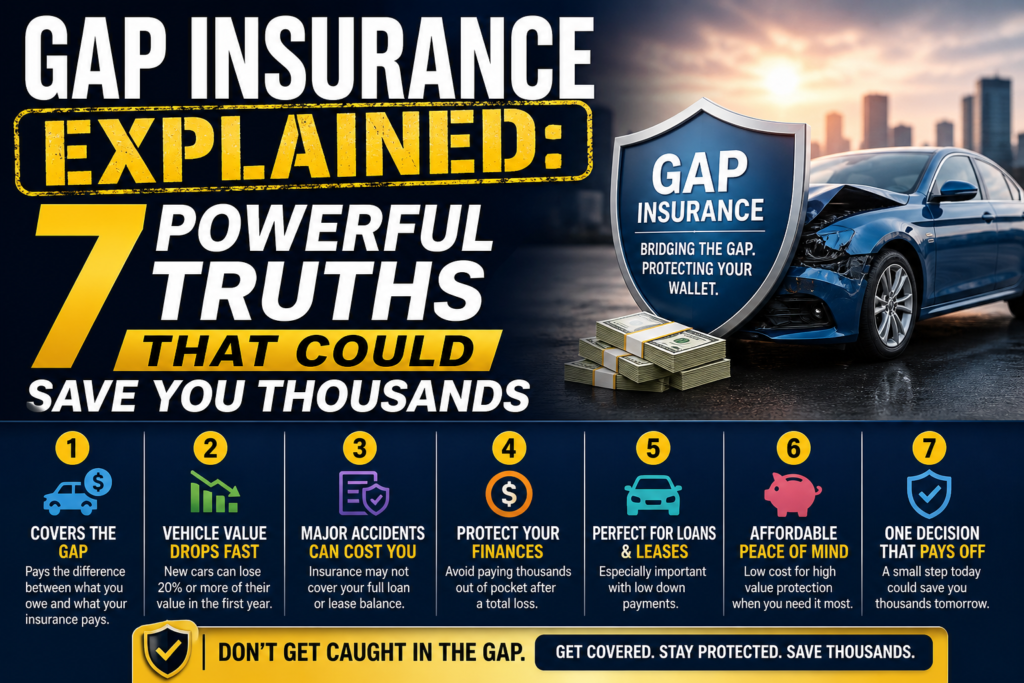
Gap insurance — which stands for Guaranteed Asset Protection — is a type of auto coverage that pays off the remaining balance on your car loan or lease if your vehicle gets totaled or stolen, after your primary insurance has already paid out.
To understand why that matters, you need to understand how car depreciation works. The moment a new vehicle leaves the dealership lot, it starts losing value. That first year alone, most new cars drop somewhere between 15 and 20 percent of what you paid for them. Meanwhile, if you financed the car, you are paying down that loan slowly — especially in the early months when more of your payment goes toward interest than principal.
So there is this window, often lasting two or three years, where your loan balance is higher than what your car is actually worth on the open market. That window is exactly where gap insurance lives.
Your regular auto insurance — the comprehensive and collision coverage — will pay you the actual cash value of your vehicle if it is totaled. The actual cash value reflects what the car is worth today, after depreciation. If that number is lower than your outstanding loan balance, you are responsible for making up the difference yourself. Gap insurance is the policy that covers that difference so you do not have to.
💡 Simple Example: You bought a car for $32,000. You put $2,000 down and financed $30,000. A year later, the car gets totaled. Your insurer says it is worth $23,000 now. Your loan balance is still $26,500. Your regular insurance pays the lender $23,000. You still owe $3,500. Gap insurance covers that $3,500.
How Does Gap Insurance Work When You File a Claim?
The actual claims process is more straightforward than most people expect, though it does involve a few moving parts. Here is what happens in practice.
When your car is declared a total loss — either because the damage from an accident is more expensive than the vehicle is worth, or because it was stolen and not recovered — your primary insurer gets to work first. They will assess the vehicle’s actual cash value, subtract your deductible, and send the net payout to your lender.
Once that payment lands, your lender applies it to your remaining loan balance. If it covers everything, you are done. If a balance remains — which is the whole scenario gap insurance is built for — that is when you contact your gap insurer and begin the second claim.
The gap insurer will ask for documentation: the settlement letter from your primary insurance, your loan payoff statement, and usually a copy of the police report if the vehicle was stolen. They review everything, calculate the shortfall, and pay the remaining amount directly to your lender.
You do not receive a personal check from gap insurance. The payment goes straight to whoever holds your loan. Your obligation to the lender is cleared, and you can move on.
What Does Gap Insurance Cover?
Gap insurance is purposefully narrow in what it covers. It is designed to solve one specific problem, and it does that well. But it is easy to assume it does more than it does, so let’s be clear on both sides.
What It Does Cover
- The shortfall between your loan payoff amount and the actual cash value your primary insurer pays out after a total loss
- Total losses from accidents, whether your fault or someone else’s
- Theft, if the car is not recovered within a reasonable period (your insurer will define this in the policy)
- Natural disaster damage that results in a total loss, such as floods, fires, or hailstorms severe enough to write off the vehicle
- Some policies will also cover a portion of your deductible, typically up to $500 or $1,000, so ask about this when comparing options
What It Does NOT Cover
- Mechanical breakdowns, engine failures, or any repair scenario where the vehicle is not a total loss
- Medical expenses, liability to other drivers, or property damage you cause to others
- Negative equity you rolled over from a previous car loan into this one — this is a common trap people miss
- Any overdue loan payments, late fees, or penalties that had already piled up before the loss
- Personal belongings inside the vehicle at the time of the loss
- Any loan amount that was inflated by add-ons like extended warranties or service contracts rolled into the financing
⚠️ Watch out for this: If you traded in a car with negative equity and rolled that balance into your new loan, gap insurance may not cover that rolled-over portion. That gap within a gap is your responsibility. Read your policy terms carefully before assuming you are fully protected.
Who Actually Needs Gap Insurance?
Not everyone does. Gap insurance is genuinely valuable in some situations and essentially pointless in others. Here is a straightforward way to think about whether it applies to you.
You Probably Need It If…
- You put less than 20 percent down when you bought the car. Smaller down payments mean you start further behind on equity.
- You are financing a brand-new vehicle. New cars depreciate fastest in the first year or two, which is exactly when the loan balance gap is largest.
- You signed up for a loan term of 60 months or longer. Longer loans mean smaller monthly payments, but they also mean you build equity in the vehicle more slowly.
- You are leasing rather than buying. Many lease agreements technically include some form of gap protection, but the terms vary significantly and some caps leave you exposed.
- You are upside down on the loan right now — meaning you owe more than the car is worth based on its current market value.
- You drive a lot of miles annually. Higher mileage accelerates depreciation, which widens the gap between your car’s value and your loan balance.
You Probably Do Not Need It If…
- You paid cash for the vehicle and have no loan involved.
- You put a large down payment down — generally 20 percent or more — and your loan balance is already below market value.
- You are well into the loan and have built up significant equity in the vehicle.
- You are financing an older used car with a short repayment term and a modest balance.
The easiest way to check your own situation: look up your vehicle’s current market value on a resource like Kelley Blue Book or Edmunds, then compare it to your current loan payoff figure from your lender. If the payoff is higher, gap insurance is worth having. If the car is worth more, you do not need it.
Gap Insurance vs. Full Coverage: They Are Not the Same Thing
One of the most common misconceptions we see is the assumption that having full coverage already includes gap protection. It does not, and that distinction matters enormously if you ever find yourself in a total loss situation.
Full coverage is a shorthand term for a combination of liability, comprehensive, and collision insurance. Liability covers damage you cause to other people and their property. Comprehensive covers non-collision losses like theft, weather, and fire. Collision covers damage to your vehicle from an accident. Together, they give you broad protection — but they all pay out based on the actual cash value of your vehicle, nothing more.
Gap insurance is a separate layer entirely. It does not replace full coverage — it works alongside it. In fact, most gap insurers require you to carry full coverage in order for a gap policy to be valid. If you want to understand more about how standard auto insurance works and what it actually covers, our complete car insurance guide breaks it down in full detail.
The short version: full coverage handles the insured value of the car. Gap insurance handles the debt. You need both if you are financing a new vehicle with a loan that exceeds the car’s depreciated value.
How Much Does Gap Insurance Cost?
Cost is where gap insurance becomes genuinely interesting, because the price varies a lot depending on where you buy it. There is no single market rate, and two drivers with identical vehicles and identical loans can end up paying very different amounts for the same protection.
Buying Through Your Auto Insurance Provider
This is almost always the cheapest route. Adding gap coverage to an existing auto insurance policy typically costs somewhere between $20 and $40 per year. At that price, it is one of the most cost-effective insurance purchases you can make for a new vehicle. If your loan is in the range where a gap could realistically form, that annual cost is practically negligible.
Buying Through a Dealership
Dealerships sell gap insurance, and they are generally not shy about pushing it at closing. The problem is the price. Dealer-sold gap policies typically run anywhere from $400 to $900, paid upfront, and that amount is often rolled into your loan — which means you are paying interest on your gap insurance. If you sell the car or pay off the loan early, getting a refund on that prepaid amount is often complicated or impossible. The coverage is usually the same as what you could get cheaper elsewhere.
Buying Through Your Lender or Bank
Some banks and credit unions offer gap coverage as part of the financing package. Prices vary. Credit unions in particular tend to offer competitive rates, sometimes comparable to what an insurance provider charges. If your lender mentions this option, get the full terms in writing and compare it against a quote from your insurer before deciding.
💰 Money-Saving Tip: Call your existing auto insurance provider first. In most cases, adding gap coverage to your current policy costs a fraction of what a dealer charges for the same protection. If you already have full coverage, it is often just a quick call or online request to add it.
How to File a Gap Insurance Claim Step by Step
Most people filing a gap claim are doing so for the first time, often under stressful circumstances. Knowing the process ahead of time makes it significantly easier.
- Report the total loss or theft to your primary auto insurer right away. Do not wait. The sooner you file, the sooner the process begins.
- Work through your primary claim fully. Your insurer will conduct their assessment, determine actual cash value, and issue payment to your lender. Get a copy of the settlement letter and the ACV determination in writing.
- Get your loan payoff statement from your lender. This is the exact amount needed to clear the loan balance at the time of the loss. It is usually different from your regular monthly statement.
- Contact your gap insurance provider. Let them know you are initiating a gap claim and ask exactly which documents they require.
- Submit all documentation: the primary insurance settlement letter, the loan payoff statement, and the police report if theft was involved. Some insurers also want a copy of your original loan agreement.
- Wait for review and approval. Gap claims typically process within a few days to two or three weeks. Your gap insurer will verify the shortfall and pay the remaining amount directly to your lender.
- Confirm in writing with your lender that the account is fully paid and closed. Keep that confirmation for your own records.
One thing worth knowing: during the gap claim period, your lender typically continues to accrue interest on the unpaid balance. The sooner you initiate the process, the less additional interest you will accumulate. If you have questions about how total loss claims work with your auto insurer, we have a full walkthrough that covers that side of the process in detail.
Gap Insurance on a Leased Vehicle
Leasing is a little different from financing, and so is the role gap insurance plays in that context.
When you lease a car, you are essentially paying for the portion of the vehicle’s value you use over the lease term. The leasing company still owns the car. If it gets totaled or stolen, your primary insurance pays the actual cash value — and the gap, in this case, is the difference between that payout and what you still owe under the lease agreement, including remaining payments, fees, and any residual value clauses.
The good news is that many lease agreements include some form of gap waiver built into the contract. The less good news is that “some form” is doing a lot of work in that sentence. Lease gap protections often have caps, exclusions, and conditions that can leave you with an unexpected bill if the circumstances of the loss fall outside those terms.
Before assuming your lease has you covered, read the gap clause carefully. If there are any conditions you are not comfortable with, buying a standalone gap policy — particularly a cheap one through your insurer — can be a reasonable additional layer of security.
Is Gap Insurance Worth the Money?
For most people buying or leasing a new car with a conventional loan, yes — gap insurance is worth it, particularly in the first two to three years of ownership.
The math is pretty straightforward. If you can add gap coverage to your auto policy for $30 a year, and you are carrying a loan where your balance is $4,000 to $8,000 higher than your car’s current market value, the coverage cost is minimal relative to the potential exposure. One bad accident or one stolen vehicle without gap insurance, and that out-of-pocket number becomes very real very fast.
Where it stops being worth it is when the loan balance drops below the car’s market value. At that point, a total loss would actually result in your insurer paying more than you owe, which means you might actually see money back. Gap insurance becomes irrelevant at that stage.
If you are not sure where you stand, check your loan statement for the payoff amount, look up your car on Kelley Blue Book or a similar resource for current market value, and compare the two numbers. If the payoff is higher, keep the gap coverage. If the car value is higher, you can drop it.The Consumer Financial Protection Bureau also offers guidance on auto loan basics and consumer protections that can be helpful if you are working through a financing decision and want an independent perspective.
Gap Insurance vs. New Car Replacement Coverage
Some insurers offer something called new car replacement coverage, and it is worth understanding how it differs from gap insurance before you make a purchase.
New car replacement coverage is a more expansive protection. If your new car is totaled within the first one or two years of ownership (the window varies by insurer), this type of policy pays for a brand-new equivalent vehicle — not just the depreciated cash value, and not just the loan payoff. You get a new car.
Gap insurance, by contrast, simply clears your debt. You are not left with a new car. You are left with no outstanding loan, which is meaningful but different.
New car replacement coverage costs more than gap insurance and typically expires after the first year or two. Gap insurance is cheaper and stays relevant for as long as you are upside down on the loan. They are solving slightly different problems, and the right choice depends on whether your priority is eliminating debt or replacing the vehicle.
If budget is a concern, gap insurance is the more affordable floor of protection. If you want to be back in a comparable new vehicle after a total loss, new car replacement coverage is the upgrade worth considering.
Frequently Asked Questions About Gap Insurance
The Bottom Line
Gap insurance is not complicated, and it is not expensive when you buy it the right way. It does one thing: it clears the difference between what your car is worth at the time of a total loss and what you still owe the lender. That difference can be thousands of dollars, and without coverage, it comes straight out of your pocket while you are also dealing with the aftermath of a totaled or stolen car.
For anyone driving a financed new vehicle, especially in the first two or three years of the loan, gap insurance is one of the more sensible financial decisions you can make. The annual cost through most insurance providers is genuinely modest compared to the exposure it eliminates.
Take five minutes to check your current loan payoff against your car’s market value. If there is a gap, close it. If there is not, you do not need to do anything. It is really that straightforward.Ready to get covered? Compare gap insurance options alongside your full auto coverage at Insuruni.com and find a policy that fits your loan, your vehicle, and your budget without overpaying.