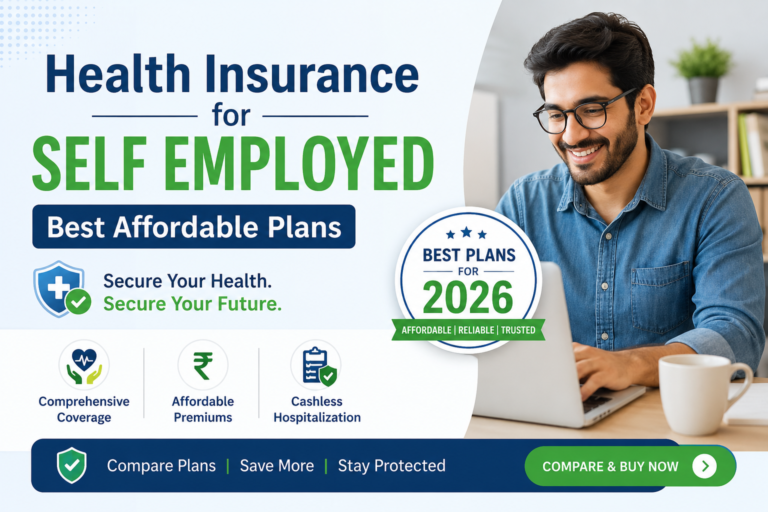

Health Insurance for Self Employed
Going self-employed is one of the most exciting decisions you can make — and one of the most complicated ones, too. You get to set your own hours, pick your own clients, and build something that’s genuinely yours. But somewhere between filing your first invoice and chasing down a late payment, a pretty important question tends to surface: what do you do about health insurance?
Unlike salaried employees who get coverage through their employer, self-employed individuals have to sort this out entirely on their own. That means comparing plans, understanding deductibles, figuring out tax deductions — the whole lot. And if you’re new to it, the process can feel genuinely overwhelming.
This guide is written for people who are actually going through this. Whether you’re a freelancer, sole trader, independent contractor, or small business owner with no staff, we’ll walk through how self employed health insurance works, what it costs, how to get it, and how to make sure you’re not paying more tax than you need to.
What Is Health Insurance for the Self Employed?
When you work for a company, your employer typically arranges group health coverage and contributes to the premium on your behalf. When you’re self-employed, none of that happens automatically. You’re responsible for finding a plan, paying the full premium yourself, and managing any renewals or changes each year.
That said, self-employed people in both the UK and US have real options available to them — it just takes a bit more legwork to find the right fit. The type of coverage you need, and where you get it, will depend on where you live, your income, and your health needs.
In the United States, most self-employed people look for coverage through the Health Insurance Marketplace (also called the ACA exchange), through a spouse or domestic partner’s employer plan, or through a professional association. In the UK, the NHS provides a baseline of free care, but many self-employed individuals also take out private health insurance to avoid waiting times and access private specialists.
For the purposes of this guide, we’ll cover both markets — but we’ll focus particularly on the US, where the cost and complexity of Self Employed Health Insurance tends to be highest.
How Much Is Self Employed Health Insurance?
This is usually the first question people ask, and honestly it’s a fair one. The short answer is: it depends. But let’s give you something more useful than that.
In the United States, the average monthly premium for a self-employed individual on a mid-tier (Silver) Marketplace plan is roughly $450 to $600 per month before any subsidies. For a family, that figure can climb to $1,200 to $1,800 per month or more, again before subsidies.
But here’s the thing — a large proportion of self-employed people qualify for premium tax credits under the Affordable Care Act, which can dramatically reduce that monthly cost. Eligibility is based on your income relative to the federal poverty level. According to the Kaiser Family Foundation, four in five people who enrolled through HealthCare.gov in 2023 qualified for financial assistance.
| Plan Tier | Avg. Monthly Premium (Individual) | Avg. Deductible |
| Bronze | $320 – $420 | $6,000 – $8,000 |
| Silver | $450 – $600 | $3,000 – $5,000 |
| Gold | $620 – $800 | $1,000 – $2,500 |
| Platinum | $800 – $1,100+ | $0 – $500 |
Source: HealthCare.gov 2024 plan data. Premiums vary by age, location, and tobacco use.
A 30-year-old non-smoker living in Texas might pay around $350 a month for a Bronze plan with no subsidies. A 55-year-old in New York might pay nearly double that for similar coverage. Age and state of residence are the two biggest variables after income.
It’s also worth comparing the monthly premium against the total potential out-of-pocket costs. A cheap Bronze plan might look attractive until you realise the deductible is $7,000 — meaning you pay the first $7,000 of medical costs every year before insurance kicks in. If you’re generally healthy and just want catastrophic protection, that might make sense. If you have ongoing health needs, a Gold or Silver plan is usually better value overall.
If you’re also budgeting for car-related costs, our guide on how much car insurance costs per month can help you get a full picture of your monthly outgoings as a self-employed person.
Is Health Insurance Tax Deductible for Self Employed?
Yes — and this is one of the most valuable financial benefits available to self-employed individuals in the US. The Self Employed Health Insurance deduction allows you to deduct 100% of your health insurance premiums from your federal income tax, provided you meet certain conditions.
Here’s what makes this deduction especially powerful: it’s an above-the-line deduction, meaning you don’t need to itemise your tax return to claim it. It reduces your adjusted gross income (AGI) directly, which in turn can lower your overall tax bracket and potentially increase your eligibility for other tax credits.
Who Qualifies for the Self Employed Health Insurance Deduction?
You can claim this deduction if:
- You were self-employed and had a net profit for the year
- You were not eligible to participate in an employer-sponsored health plan — including through a spouse’s employer
- The insurance plan was established in your name or under your business
- You paid the premiums yourself (they weren’t reimbursed by any other party)
The deduction covers premiums for medical, dental, and vision coverage for yourself, your spouse, and your dependants. It also covers premiums for qualifying long-term care insurance, subject to age-based limits.
One catch worth knowing: the deduction cannot exceed your net self-employment income. If you had a low-income year, you can only deduct up to what you actually earned. The excess can’t be carried forward, unfortunately.
According to the IRS Publication 535 on Business Expenses, the deduction is claimed on Schedule 1 of Form 1040. It’s separate from medical expenses claimed on Schedule A, and you can only use one method per policy.
What About National Insurance and Tax in the UK?
In the UK, self-employed individuals pay Income Tax and National Insurance Contributions (NICs) on their profits. Private health insurance premiums are not tax-deductible for sole traders in the same way they are in the US — they’re treated as a personal expense.
However, if you operate through a limited company, the company can pay for private health insurance as a business benefit, which is treated as a benefit-in-kind and subject to Income Tax for the employee (you). The company can then deduct the cost as a business expense, reducing its Corporation Tax bill. It’s worth speaking to an accountant about the most tax-efficient structure for your situation.
How Do Self Employed People Get Health Insurance?
There are several routes, and the best one for you will depend on your income, your health needs, and whether you’re in the US or UK. Let’s walk through the main options.
The ACA Health Insurance Marketplace (US)
The Health Insurance Marketplace — also called the exchange — is the primary route for self-employed Americans. You can enrol during the annual Open Enrollment Period, which typically runs from November 1 to January 15 in most states. If you have a qualifying life event (like losing previous coverage or getting married), you may qualify for a Special Enrollment Period outside of that window.
Plans on the Marketplace are categorised by metal tier: Bronze, Silver, Gold, and Platinum. Each tier represents a different balance between monthly premiums and out-of-pocket costs. For self-employed people who are eligible for premium tax credits, Silver plans often work out best — they offer a reasonable balance of cost and coverage, and they’re the only tier that qualifies for cost-sharing reductions if your income is low enough.
You can browse and compare plans at HealthCare.gov or through your state’s own exchange if you live in California, New York, Colorado, or another state that runs its own marketplace.
Medicaid (US)
If your self-employment income is low, you may qualify for Medicaid — the joint federal-state programme that provides free or very low-cost health coverage. In states that have expanded Medicaid under the ACA, eligibility extends to adults with incomes up to 138% of the federal poverty level.
As a self-employed person, your income can fluctuate significantly from year to year, so it’s worth checking your Medicaid eligibility each year when you file. The US Department of Health & Human Services has detailed information on state-by-state Medicaid eligibility.
A Spouse or Domestic Partner’s Plan (US)
If your spouse or domestic partner has employer-sponsored Self Employed Health Insurance, you may be able to join their plan as a dependent. This is often one of the most cost-effective options available, since employer group plans typically have lower premiums than individual plans on the open market. There’s no requirement that you pay taxes in the same state or have a certain income.
Bear in mind that if you’re eligible for a spouse’s employer plan, you generally cannot claim the Self Employed Health Insurance deduction for any premiums you pay yourself — the eligibility rules specifically exclude people who could have participated in an employer plan.
Professional Associations and Trade Groups
Some trade associations, professional guilds, and industry groups offer group health coverage to members. The National Association for the Self-Employed (NASE), freelance unions, and associations specific to your industry (like the Freelancers Union or various contractors’ groups) sometimes negotiate group rates that can be more competitive than individual plans.
These plans vary widely in quality, so read the fine print carefully before committing — particularly around out-of-pocket limits and network coverage.
COBRA Continuation Coverage
If you’ve recently left employment to go self-employed, you may be eligible for COBRA continuation coverage — which lets you stay on your former employer’s plan for up to 18 months. The downside is that you pay the full premium, including the portion your employer used to cover, plus a 2% admin fee. This can make COBRA quite expensive, but it’s useful as a short-term bridge while you assess your options.
Private Health Insurance in the UK
In the UK, self-employed individuals already have access to NHS care, but many opt for private health insurance to cover faster access to specialists, private hospital rooms, and treatments not always available on the NHS. Providers like Bupa, AXA Health, Vitality, and Aviva all offer individual and family policies.
Premiums vary based on your age, the level of cover you choose (inpatient only, outpatient, dental, mental health), and any pre-existing conditions. Basic inpatient cover for a healthy 35-year-old might cost around £50 to £80 per month. Comprehensive cover with outpatient and dental could run to £150 or more.
Best Self Employed Health Insurance What to Look For
There’s no single plan that’s the “best” for every self-employed person — it really does depend on your circumstances. But there are certain criteria that tend to matter most for people who are striking out on their own.
Network Coverage
Make sure your preferred doctors, specialists, and local hospitals are in the plan’s network. Out-of-network care can be dramatically more expensive, and in some plan types (like HMOs), it may not be covered at all. This matters especially if you have ongoing relationships with specific healthcare providers you don’t want to disrupt.
Total Annual Cost, Not Just the Premium
A lot of people compare plans purely by monthly premium and pick the cheapest one. That can be a mistake. The real cost of a plan includes the premium, the deductible, and the out-of-pocket maximum. If you end up needing significant medical care, a plan with a low premium but a £6,000 deductible can end up costing far more than one with a higher monthly rate but a lower deductible.
Prescription Coverage
If you take regular medications, check the plan’s drug formulary carefully before enrolling. Formularies vary significantly between plans, and a medication that’s covered at low cost on one plan might be in a higher tier (or not covered at all) on another.
Mental Health Coverage
Under US law (the Mental Health Parity and Addiction Equity Act), most insurance plans must cover mental health and substance use treatment comparably to physical health care. However, the quality and accessibility of that coverage varies considerably. If mental health support is important to you, look specifically at therapy visit limits and whether telehealth mental health services are included.
Flexibility for Irregular Incomes
Self-employment income can vary considerably from month to month. If you think your income might fluctuate in ways that affect your subsidy eligibility, look into whether you can update your projected income mid-year on the Marketplace. Making regular updates reduces the risk of owing money back when you file your taxes.
Quick Comparison Best Self Employed Health Insurance (US)
| Plan Type | Best For | Key Benefit | Potential Drawback |
| ACA Silver Plan | Most self-employed individuals | Tax credit eligible; cost-sharing reductions | Moderate deductibles |
| ACA Bronze Plan | Healthy, low-risk individuals | Lowest monthly premium | Very high deductibles |
| ACA Gold Plan | Frequent healthcare users | Lower out-of-pocket costs | Higher monthly premiums |
| Health Share Plan | Budget-conscious; faith-based | Lower monthly cost | Not regulated insurance; gaps possible |
| Association Group Plan | Members of trade groups | Group pricing; broad coverage | Requires membership; varies by group |
How to Get Self Employed Health Insurance A Step-by-Step Guide
If you’re starting from scratch, here’s a practical walkthrough of how to get covered.
Work Out Your Projected Annual Income
Your income determines whether you qualify for subsidies in the US, or whether Medicaid is an option. As a self-employed person, you’ll need to estimate your net income (after business deductions) for the year ahead. If it changes significantly, you can update this on the Marketplace.
Check Marketplace Eligibility and Subsidy Amounts
Head to HealthCare.gov (or your state exchange) and use the eligibility tool to see what plans and subsidies are available at your projected income. This will give you a realistic view of what your actual monthly cost would be after tax credits.
Compare Plans — Not Just Premiums
Use the Marketplace comparison tools to look at deductibles, out-of-pocket maximums, copays, and network providers. Don’t just sort by monthly cost. Think about how often you typically use healthcare services and choose accordingly.
Enrol Within the Right Window
If you’re starting self-employment and losing employer coverage, you qualify for a Special Enrollment Period. You have 60 days from the date you lose coverage to enrol. If you miss that window, you’ll need to wait for Open Enrollment unless you have another qualifying life event.
Claim Your Tax Deduction
When you file your taxes, include your health insurance premiums on Schedule 1 of Form 1040 using the Self Employed Health Insurance deduction. Keep records of all premiums paid throughout the year. If you use accounting software or work with an accountant, flag this as a recurring deductible expense.
Common Mistakes Self Employed People Make With Health Insurance
Waiting Until They’re Sick
It sounds obvious, but a surprising number of self-employed people go without health insurance and only start thinking about it when they need to see a doctor. Under the ACA, you can only enrol during Open Enrollment or if you have a qualifying life event. Missing that window can leave you uninsured for months.
Choosing the Cheapest Plan Without Reading the Fine Print
A Bronze plan with a $7,000 deductible is not cheap if you need a hospitalisation or specialist visit. Always calculate your total potential out-of-pocket exposure, not just the monthly premium.
Not Updating Income Estimates on the Marketplace
If your income changes significantly during the year and you don’t update it, you could receive more tax credits than you’re entitled to — and have to pay the difference when you file your taxes. Update your income estimate as soon as you have a clearer picture.
Forgetting to Claim the Deduction
According to the IRS, many self-employed individuals who pay their own health insurance premiums fail to claim the deduction. It’s easy to overlook if you’re self-filing. Don’t leave this money on the table.
Not Checking Whether a Spouse’s Plan Is Available
If a spouse or domestic partner has employer coverage, you may be able to join their plan — often at lower cost than individual Marketplace plans. Always check this option before purchasing a plan on your own.
Health Insurance Costs vs. Other Expenses Budgeting as a Self-Employed Person
Self Employed Health Insurance is one of several major insurance costs you’ll face as a self-employed individual. You may also be dealing with professional indemnity insurance, public liability cover, income protection, and — of course — vehicle cover if you drive for work.
If you’re shopping for car insurance alongside health coverage, it’s worth comparing comprehensive quotes. Our car insurance quotes tool makes it easy to find competitive rates in your area. And if you’re already covered with a provider, you might find our breakdown of Direct Line car insurance and Quote Me Happy helpful when it’s time to renew or switch.
As a broad budgeting rule, financial advisers typically suggest that self-employed individuals set aside around 20–30% of their gross income to cover taxes and insurance costs combined. For someone earning $60,000 net, that means roughly $12,000 to $18,000 a year — a meaningful chunk, but manageable when factored in from the start.
Self Employed Health Insurance UK vs. US at a Glance
| Factor | United Kingdom | United States |
| Base healthcare access | NHS (free at point of use) | None by default |
| Private insurance purpose | Faster access, private facilities | Primary coverage |
| Average monthly cost | £50 – £150 (private supplement) | $350 – $800 (primary plan) |
| Tax deductibility | No (sole trader); possible via Ltd company | Yes — 100% deductible from gross income |
| Subsidy availability | Not applicable | ACA premium tax credits based on income |
| Main providers | Bupa, AXA, Vitality, Aviva | Blue Cross, Aetna, UnitedHealth, Kaiser |
Frequently Asked Questions
Final Thoughts Health Coverage Is Part of Running a Successful Business
There’s a tendency among self-employed people to treat health insurance as an optional extra — something to sort out “later” once business picks up. That mindset is understandable, but it carries real risks. One unexpected illness or injury can result in thousands of dollars or pounds of out-of-pocket medical costs if you’re uninsured.
The good news is that once you understand how the system works, getting health insurance as a self-employed person is entirely manageable. In the US, the combination of ACA Marketplace access and the Self Employed Health Insurance deduction makes coverage more affordable than many people assume. In the UK, the NHS provides a solid foundation, with private coverage available if you want more control over timing and access.
Take the time to compare plans properly — not just by premium, but by total potential cost. Claim every deduction you’re entitled to. And review your coverage annually to make sure it still matches your income and health needs.
If you’re managing multiple insurance products as a self-employed person, tools like Travelers Insurance login can help you keep your existing policies organised alongside any new coverage you take out. And if you’re starting out and want to understand how different insurance products interact with your overall budget, our car insurance quotes guide is a good starting point for thinking through vehicle coverage in the same systematic way.
Being your own boss means making decisions that employees never have to think about. Self Employed Health Insurance is one of them. Get it right, and it’s one less thing keeping you up at night.